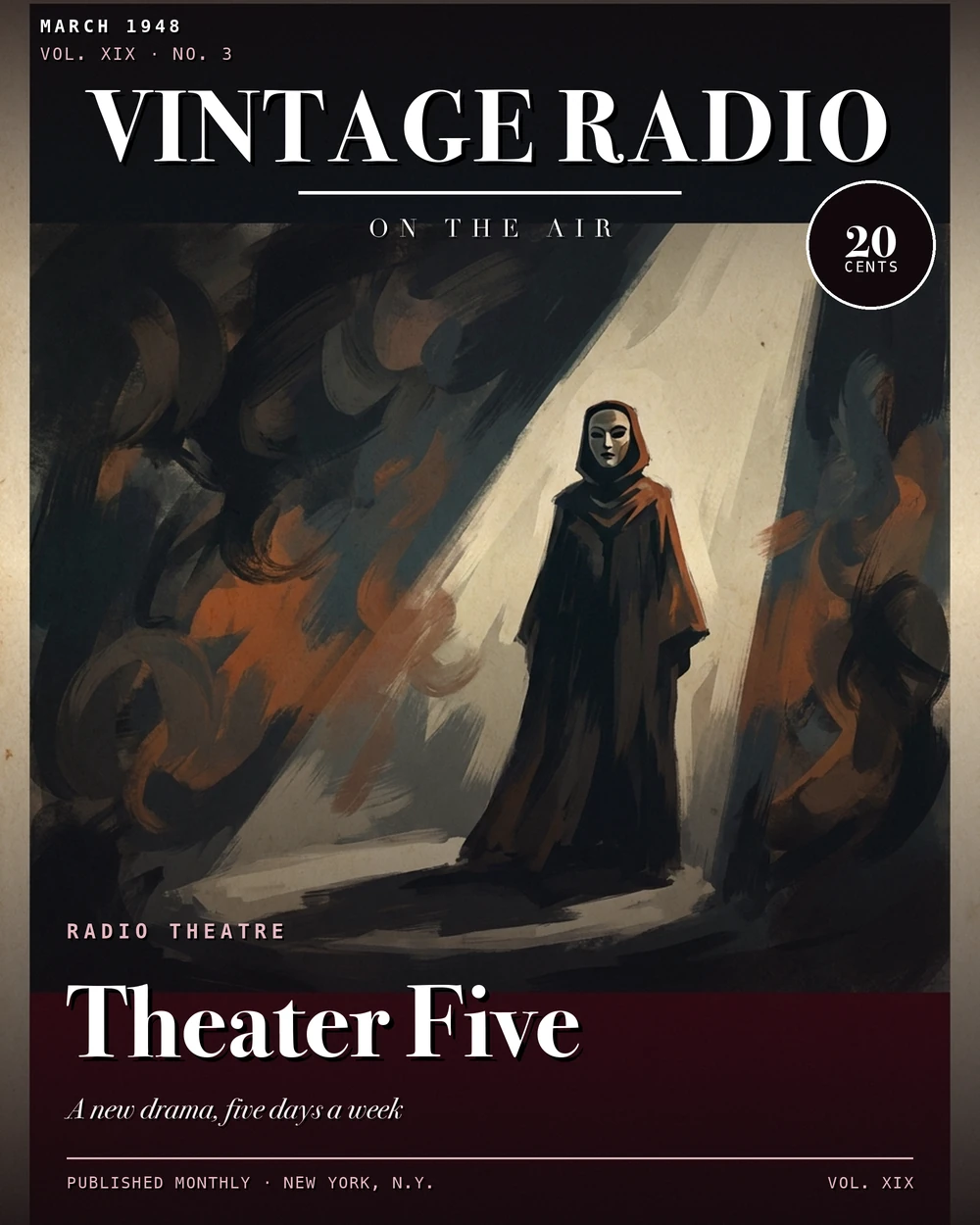
Theater Five
The Last Serious Bet on Radio Drama
In the spring of 1964, ABC made a genuine effort to bring dramatic radio back to American airwaves. The network had been planning the move for more than a year before it settled on executive producer Ed Byron to run the project. Byron was a logical choice — he had created Mr. District Attorney and built Moon River at WLW Cincinnati, and was described as "a pioneer in radio dramatic production." He came off a stint at NBC, where he'd been working in special program sales since 1960, and threw himself into the Theater Five project with real conviction. The show debuted August 3, 1964, airing on weekdays in a 30-minute slot, and ran until July 30, 1965. It was an anthology: a different story every day, five days a week, originating out of New York on the ABC Radio Network.
Byron understood that to make it work, he needed writers who would take the assignment seriously. He offered 40 percent above union scale for scripts — a meaningful premium intended to attract experienced talent rather than whoever happened to be available. Most of the resulting scripts were originals written specifically for the series, though some appear to have been adapted from earlier radio work. A handful of episodes were remakes of stories that had aired on other programs, including at least one traced back to 2000 Plus and another whose storyline had also appeared in Beyond Midnight. The range of genres was wide: comedy, melodrama, supernatural, science fiction, and stories touching on topical issues of the day.
Byron didn't live to see the series finish. He died on November 21, 1964, in New Haven, Connecticut — barely four months into the run. He had been born in Newport, Kentucky, and educated at the University of Cincinnati. His death left the production in the hands of the directors who had been working alongside him.
The Shape of the Show
The title came straight from the clock: Theater Five aired at 5:00 PM. The ABC Radio Network's advance schedule for January 1965 actually shows the program fed to affiliates in two windows — 2:30 to 2:54 PM EST and again 10:29 to 10:54 PM EST, Monday through Friday — so the name reflected the original slot even as the distribution spread out.
Within that 30-minute block, the drama itself ran only about 19 to 20 minutes. News programs and commercials filled the rest. That compression was a real constraint. A 1930s radio drama in a comparable slot typically gave writers 25 minutes or more to work with; Theater Five gave them about four minutes less than that. Critics noticed. Contemporary reviewers argued that the format didn't leave enough room to build genuine tension — that just as a story found its footing, it had to close. Whether that assessment is fair to every episode is debatable, but the math was real, and writers working in the format had to think differently about structure than radio dramatists had in the medium's earlier decades.
The theme music took a different approach than the orchestral underscoring that had defined classic radio drama. It had a "racy, Peter Gunn-like" quality — a hip, bongo-jazz sound that suited the mid-1960s moment and signaled that the show wasn't trying to imitate the drama of the 1940s.
Direction fell primarily to two men. Ted Bell directed 134 episodes across the run; Warren Somerville directed 108. William Gately handled four episodes, Harry Nelson three, and Fred Foy one. Roughly 260 episodes were produced in total, with ten whose director has not been identified.
The Company That Made It
The announcer and narrator was Fred Foy, who had joined ABC's New York staff in 1961. Before Theater Five, Foy was best known for narrating The Lone Ranger on radio from 1948 to 1955, working out of WXYZ in Detroit. Radio historian Jim Harmon called him "the announcer, perhaps the greatest announcer-narrator in the history of radio drama." Foy was later inducted into the National Radio Hall of Fame in March 2000 and received the Golden Boot Award in August 2004. On Theater Five he served as host and narrator throughout the run.
The regular repertory cast included Paul McGrath, Guy Sorel, Ruth Yorke, Cliff Carpenter, Elliott Reid, Bryna Raeburn, Court Benson, George O. Petrie, Brett Morrison, Jackson Beck, and Robert Dryden. That core rotated through the daily stories in different configurations, with a large supporting roster filling in around them — Vicky Vola, Luis Van Rooten, Peter Fernandez, Ralph Bell, Margaret Hamilton, Joan Lorring, Donald Buka, Teri Keane, and dozens of others drawn from New York's working radio and theater community.
Romeo Muller came through the show in both capacities — as an actor and as a writer. He would go on to write the television special Rudolph the Red-Nosed Reindeer for Rankin/Bass Productions, but in 1964 and 1965 he was working in New York radio.
Early Roles Worth Noting
Theater Five caught a few actors at early points in careers that would go considerably further. James Earl Jones appeared in "Incident on US 1" during the 1965 run, years before his stage and screen work made him a household name. Alan Alda, well before M*A*S*H, took a role in "A Bad Day's Work." Ed Begley — who had won the Academy Award for Best Supporting Actor in 1962 for Sweet Bird of Youth — appeared in "The Pigeon" roughly three years after that win.
None of these appearances defined the show, but they suggest that Theater Five was drawing from a real talent pool. The New York radio world in the mid-1960s still had depth, and a daily anthology with competitive script rates and a respected production team could attract working actors at various stages of their careers.
How the Run Ended and What Survived
Theater Five closed on July 30, 1965 — roughly one year after it had started. ABC's experiment in radio drama revival ended with the series. The network had invested real resources in the attempt, and the show had produced roughly 260 episodes in its single year, but it didn't find a path to continuation.
The recordings that survived became a documented set. The surviving recordings were certified accurate on December 11, 2006, accounting for 256 circulating episodes across seven CDs. A subsequent preservation effort called "The Theatre 5 Project" worked to improve on that set, replacing recordings that suffered from hum, hiss, and tape noise with cleaner source material. The result is one of the more completely documented short-run anthology series from the final years of American network radio drama.
Theater Five remains an honest document of what daily radio drama looked like at the end of its commercial run — its constraints, its craft, its reach for writers and actors who might have worked in a different medium entirely. It didn't save radio drama, but it tried with more care than most efforts of its kind.